Planning a wedding for 2027 or 2028? Before you book a single supplier, read this.
I spent around thirty years photographing fashion before devoting my work to weddings. If that career taught me one quiet truth about beautiful images, it is this: they are never an accident. They are planned. Not stiff, not staged, but planned, in the sense that the conditions for great photographs are decided weeks and months before anyone lifts a camera.
These are the ten rules I share with every couple I work with. They are drawn from my own experience of photographing weddings and, before that, editorial shoots, so treat them as professional opinion from one photographer rather than industry statistics. Where your own venue, celebrant or planner advises differently for your specific day, listen to them. They know your wedding. I know light, timing and what survives in a photograph.
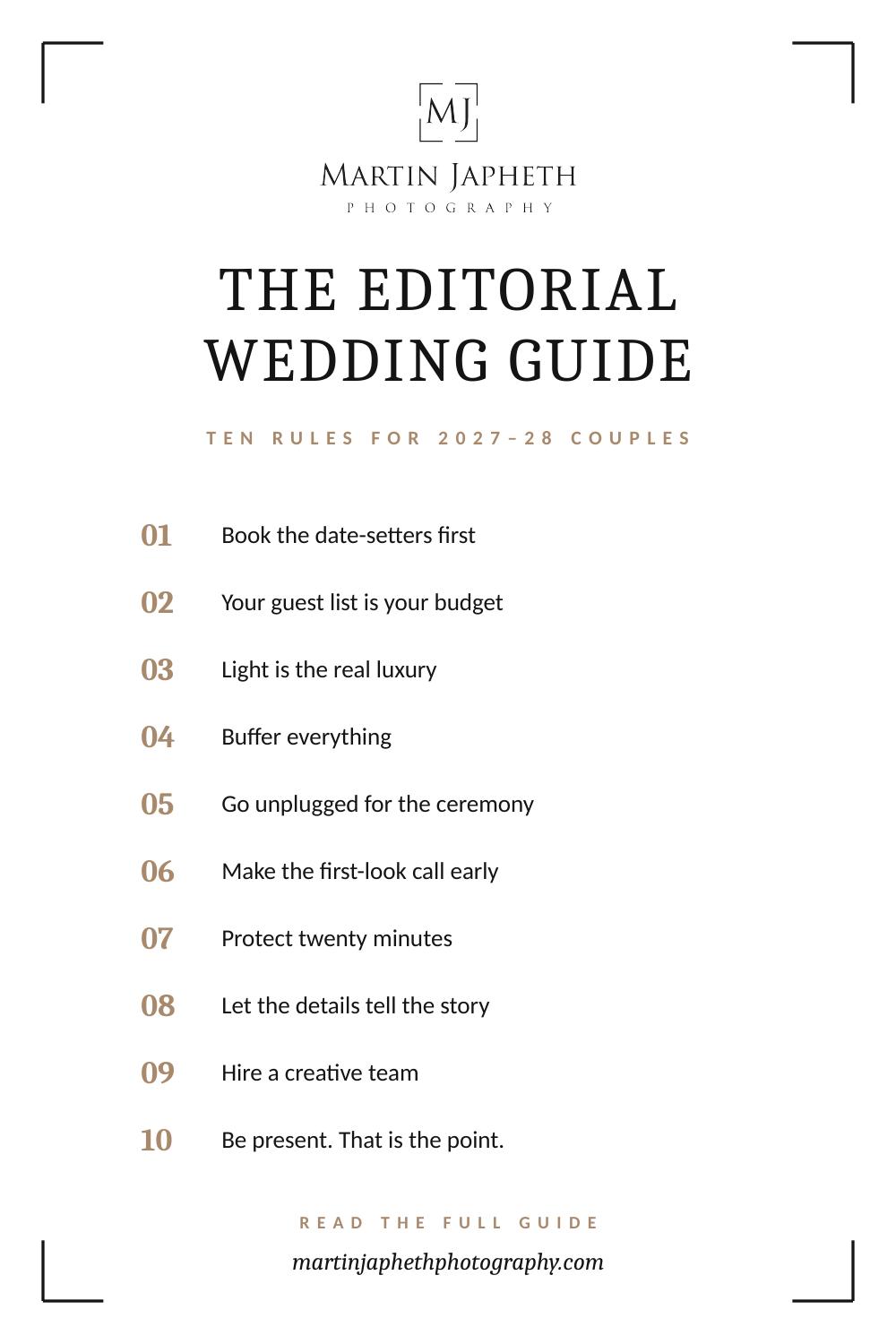
Rule 01: Book the date-setters first
Your venue and your photographer are the two suppliers booked to a single, fixed date, and in my experience the most sought-after of both are reserved a year or more in advance, often 12 to 18 months. Secure these two first. Flowers, cake, stationery and almost everything else can flex around a date once it exists. These two cannot.
There is a photographic reason as well as a practical one. The venue decides your backdrops, and the photographer decides how those backdrops are used. Locking both early means every later decision, from timings to table plans, can be made with the pictures in mind.
Rule 02: Your guest list is your budget
Every name on the list is a meal, a chair, a stationery suite and a slice of cake. Before you fall in love with anything, agree the number between you. In my experience, trimming the guest list frees more money than trimming any individual supplier, because each guest multiplies across several cost lines at once.
This is not about having a small wedding. It is about deciding the size deliberately, before the size decides your budget for you.
Rule 03: Light is the real luxury
Ask any photographer what makes a portrait flattering and the honest answer is light before anything else. The soft, low, directional light in the hour around sunset is the most forgiving and the most romantic you will get all day, which is why photographers call it golden hour.
So build the timeline around the light, not the other way round. Ask your photographer what time the sun sets on your date at your venue, and protect a short window near it. I plan this with every couple I work with, because I would rather move a speech by twenty minutes than lose the best light of the day.
Rule 04: Buffer everything
Hair overruns. Traffic happens. A beloved grandparent wanders off just before the group photographs. None of this is a failure of planning; it is simply what live events do. The couples who enjoy their day most are the ones whose timeline expected it.
My advice is to add around fifteen minutes of slack to every block of the day. A relaxed day looks relaxed in the photographs, and a rushed one does too. You cannot edit stress out of a face.
Rule 05: Go unplugged for the ceremony
One raised phone in the aisle can sit in the middle of the single most important frame of the day, the moment you first see each other. It happens more often than couples expect, and it is not recoverable in editing without compromise.
Ask your celebrant to invite guests to put devices away for the twenty minutes of the ceremony. Your guests get to be fully present, you get a clean aisle, and everyone gets the professional photographs afterwards anyway. In my experience, guests are relieved to be given permission to simply watch.
Rule 06: Make the first-look call early
A first look means seeing each other privately before the ceremony. Waiting for the aisle keeps the tradition and concentrates the emotion in one public moment. Neither choice is wrong, and I have photographed both beautifully.
What matters is deciding early, because the choice shapes your entire timeline. A first look unlocks daylight for portraits and often calms nerves. Waiting for the aisle compresses portraits into the time after the ceremony, which is fine if the timeline is built for it. Decide this before you build the running order, not after.
Rule 07: Protect twenty minutes for portraits
Editorial portraits are made, not grabbed. The images that look like they belong in a magazine come from short, unhurried sessions where a couple has space to breathe, not from moments snatched between courses.
My advice is to ring-fence two short sessions alone together across the day, roughly twenty minutes each, ideally one of them near golden hour. Twenty unhurried minutes will outperform an hour squeezed and interrupted. Your guests will barely notice you have gone, and you will come back to the party with a moment that was only yours.
Rule 08: Let the details tell the story
The gown, the shoes, the rings, the invitations, a bottle of perfume, a handwritten letter. These objects carry the story of the day, and photographed well they read like a magazine still life.
The practical rule is simple: gather them in one box on the wedding morning, in the getting-ready room, so they can be styled and photographed while you have your coffee. Hunting for a ring box at the bottom of a suitcase costs calm morning time that is better spent with your people.
Rule 09: Hire a creative team, not a list of vendors
You will spend more of your wedding day in the company of your photographer than with almost any individual guest. That is simply how the day works: we are there from preparations to the dance floor.
So choose people whose work you love and whose company you genuinely enjoy. Speak to them before you book. Trust is not an abstract nicety; it shows up in the pictures, because people photograph differently when they feel at ease with the person holding the camera.
Rule 10: Be present. That is the point.
The day moves faster than any day of your life. Every couple says so afterwards, and no timeline fully prevents it. So eat the food. Hold hands. Stand still for a moment and look at the room you built and the people in it.
Remembering it is my job. Living it is yours.
A note on who is writing this
I am Martin Japheth, a fashion-editorial wedding photographer based in North Wales, working across Cheshire, the Cotswolds, the Lake District and London. My background is around thirty years of commercial fashion photography, which shapes how I direct, light and edit weddings. My work has been recognised as a Rock My Wedding Recommended Supplier for 2026 and as a Welsh Wedding Awards Finalist in 2025, and I am a member of Vogue PhotoVogue, the WPJA and the SWPP.
Everything above is professional opinion drawn from that experience rather than survey data, and your own suppliers may reasonably advise differently for your specific venue and plans.
Planning a 2027 or 2028 wedding?
I am currently taking enquiries for 2027 and 2028 dates. Collections begin from £2,000, with full details on request.
If your wedding deserves to be photographed like a story, I would love to hear about it. Enquire at martinjaphethphotography.com.